How to Split a Large eLearning Course into Smaller Modules
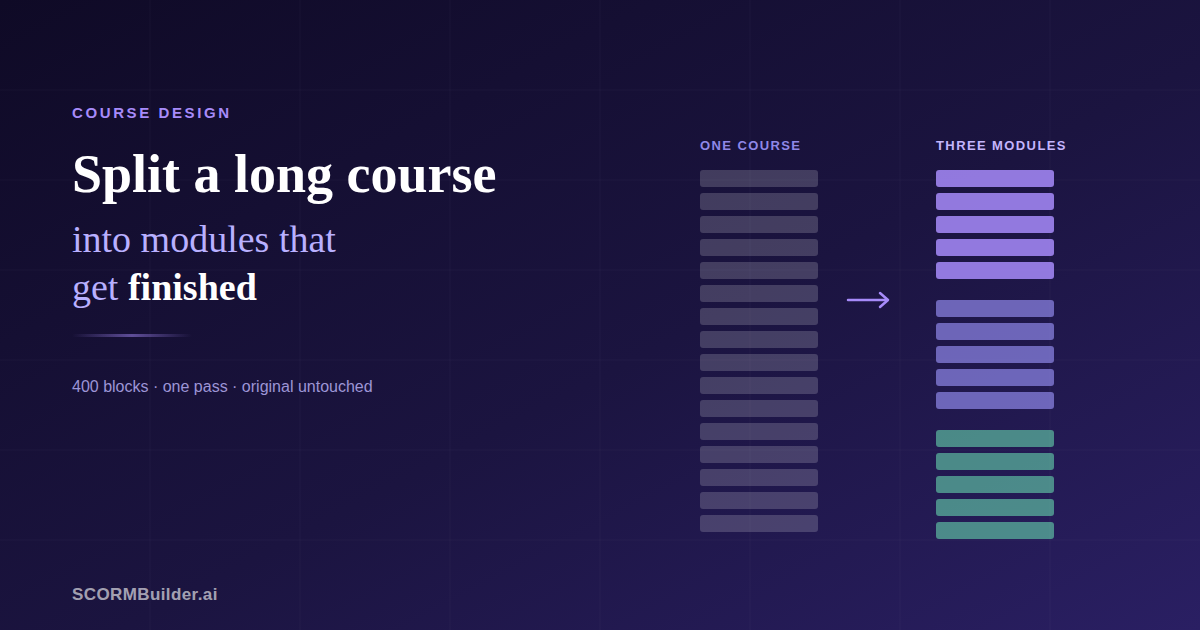
There is a moment in most large eLearning projects where the course stops being a course and becomes a problem. Usually it arrives around the four-hundred-block mark: the thing works, the content is good, and nobody can face opening it.
Long courses fail in specific ways. Learners abandon them halfway. Assigning one means assigning all of it, including the third of it a particular person does not need. And when a policy changes, updating the affected section means republishing and re-testing the entire package.
The answer is to break it into modules. The question is how to do that without rebuilding the whole thing.
The way most people do it, and why it hurts
Take a 400-block course that needs to become thirteen modules. The obvious approach:
- Duplicate the course
- Delete everything except module one
- Rename it
- Duplicate the original again
- Delete everything except module two
- Repeat eleven more times
That is roughly five thousand deletions, and every one is a chance to remove the wrong block. Worse, if you duplicate the copy rather than the original each time, mistakes compound — you are deleting from something you already edited.
It works. It takes an afternoon, and the afternoon is miserable.
One thing worth doing if you are stuck with this method: always duplicate the original, never the copy. That way a mistake costs you one module rather than every module after it.
Deciding where the breaks go
This is the part worth slowing down for, because a badly placed break is worse than no break at all.
Use the boundaries the content already has. Most long courses were written with headings marking natural sections. Those headings are usually the right split points — the author put them there because the subject changed. You are not inventing structure; you are honouring what is already in the document.
Beware of splitting by length. “Twenty blocks each” produces modules that end mid-thought, and a learner who finishes module three without resolution will not trust module four to explain it.
Each module should be describable in a sentence. “Recognising a safeguarding concern.” “Escalating a complaint.” If you cannot summarise one in a sentence, it is probably two modules pretending to be one.
Watch for orphaned references. A long course often says “as we saw earlier” or “building on the previous section”. Once that content is a separate module, those sentences point at nothing. Search for them before you publish.
What changes once a course becomes several
The LMS side gets better and busier. Each module is its own SCORM package with its own completion and score, so your reports show progress per module rather than one all-or-nothing result. That is genuinely more useful. It also means several activities to create and maintain in the LMS instead of one, and learners see a list rather than a single link.
Assessment needs a decision. If a module can be assigned on its own, it needs its own assessment — otherwise the LMS has nothing to record a pass against. Where modules are always taken in sequence, one assessment at the end usually tests more honestly: whether the whole thing stuck, rather than whether each part survived ten minutes.
Shared assets stay shared. Your branded blocks, your scenarios, your house-style callouts should not be rebuilt thirteen times. If your authoring tool keeps a reusable block library, the modules can all draw on the same one.
Doing it in one pass
Some authoring tools can split a course directly. In SCORMBuilder it is a Split action in the editor: you see every block in order with its number, type and first line, click between any two to mark where a new course begins, name the results, and confirm.
Thirteen modules from 400 blocks in one pass, in original order, with the source course untouched. If a split comes out wrong you delete the new courses and try again — nothing is lost, which is what makes it safe to experiment with.
There is also a Break at every heading shortcut, which sets the split points at your existing section headings and lets you adjust from there. For most long courses that is nearly the whole job.
Start smaller than you think
A last piece of advice, learnt the hard way by most people who have done this.
The first time you split a long course, resist the urge to get the structure perfect. Break it roughly along its headings, publish it, and watch what learners actually do. Completion rates per module will tell you within a fortnight which ones are too long and which two should have stayed together.
Structure you guessed at is a hypothesis. Structure you corrected after watching people use it is a design.
Split a course in SCORMBuilder — free for 14 days, no card required.
Frequently Asked Questions
Why split a long eLearning course into modules?
Three reasons, and only the first is about the learner. Shorter modules get finished, because a 90-minute course needs a 90-minute gap in someone's day and a 15-minute one does not. Modules can be assigned separately, so a new starter gets all eight and an experienced hire gets only the two they need. And when a policy changes you republish one module rather than re-testing the whole course.
How long should an eLearning module be?
Ten to twenty minutes is the range most corporate training settles on, which is roughly 20 to 40 content blocks. The honest answer is that length matters less than coherence: a module should cover one thing a learner could describe in a sentence. If you cannot summarise it in a sentence, it is probably two modules.
Where should the breaks go in a long course?
On the boundaries the content already has. Most long courses were written with headings marking natural sections, and those headings are usually the right split points — the author put them there because the subject changed. Be wary of splitting purely by length, which produces modules that end mid-thought.
Do I have to rebuild the course to split it?
No, and you should not. Duplicating the whole course once per module and deleting the parts you do not want is how most people do it, and it is hours of work with a real risk of deleting the wrong thing. An authoring tool that can split a course directly does the same job in one pass with the original left untouched.
Does splitting a course affect SCORM tracking?
Yes, and usually for the better. Each module becomes its own SCORM package with its own completion and score, so your LMS reports progress per module rather than one all-or-nothing result. The trade-off is that you now manage several activities in the LMS instead of one, and your learners see a list rather than a single link.
Should every module have its own quiz?
If the module is assignable on its own, it needs its own assessment — otherwise there is nothing for the LMS to record a pass against. Where modules are always taken as a sequence, a single assessment at the end is usually better: it tests whether the whole thing stuck rather than whether each part was remembered for ten minutes.